Showing posts with label bird flu. Show all posts

Friday, April 04, 2008

WHO | Avian influenza – situation in Pakistan - update 2

The two best kept secrets in Pakistan

The first secret is, 'Where is Osama bin Laden?'. Secret number two is that there was confirmed Human-to-Human (H2H) spread of Avain flu in Pakistan more than 5 months ago. Here's the complete info release from the WHO:

WHO | Avian influenza – situation in Pakistan - update 2

3 April 2008

Two additional H5N1 cases were confirmed by serological testing, thus providing final H5N1 infection test results on a previously reported family cluster in Peshawar.

These tests were conducted by the WHO H5 Reference Laboratory in Cairo, Egypt and the WHO Collaborating Centre for Reference and Research on Influenza in Atlanta, USA. The table below summarises the testing results of the confirmed/probable cases in the family cluster.

  • The preliminary risk assessment found no evidence of sustained or community human to human transmission.
  • All identified close contacts including the other members of the affected family and involved health care workers remain asymptomatic and have been removed from close medical observation.

These laboratory test results support the epidemiological findings from the outbreak investigation in December 2007, and the final risk assessment that suggested limited human to human transmission likely occurred among some of the family members which is consistent with some human-to-human transmission events reported previously. This outbreak did not extend into the community, and appropriate steps were taken to reduce future risks of human infections.

Relationship Onset Date Outcome Exposure Status
Case 1 (Index case) 29 Oct 07 Fully recovered Direct contact sick/dead poultry Confirmed (serology)
Case 2 12 Nov 07 Dead (19 Nov 07) Close contact with Case 1, no known direct contact with sick/dead poultry Probable
(No sample available)
Case 3 21 Nov 07 Dead (28 Nov 07) Close contact with Case 1 and 2, no known direct contact with sick/dead poultry Confirmed (PCR)
Case 4 21 Nov 07 Fully recovered Close contact with Case 1 and 2, no known direct contact with sick/dead poultry Confirmed (serology)

It is great news that the H2H transmission burned out before it hit the wider community. But many aspects of this news are troubling. First and foremost is the credibility of the WHO reporting. It seems that we hear complete details if a single duck shows up with H5N1 in Eureka-stan; why such a delay for major news such as H2H?

Speaking of credibility, contrast today's news with this Reuters article on December 28, 2007:

No proof of human-to-human bird flu in Pakistan No evidence that bird flu passed between relatives, WHO says

Reutersupdated 1:10 p.m. ET, Fri., Dec. 28, 2007

GENEVA -The World Health Organization said on Thursday it had established a single case of human infection of the H5N1 bird flu virus in a sick family in Pakistan but there was no apparent risk of it spreading further.

A statement from the U.N. agency said tests in its special laboratories in Cairo and London had established the “human infection” through presence of the virus “collected from one case in an affected family.”

But it said a WHO team invited to Pakistan to look into an outbreak involving up to nine people from late October to December 6 had found no evidence of sustained or community human-to-human transmission.

No identified close contacts of the people infected, including health workers and other members of the affected family, had shown any symptoms and they had all been removed from medical observation, the WHO added.

The outbreak followed a culling of infected chickens in the Peshawar region, in which a veterinary doctor was involved. Subsequently he and three of his brothers developed proven or suspected pneumonia.

The brothers cared for one another and had close personal contact both at home and in hospital, a WHO spokesman in Geneva said. One of them, who was not involved in the culling, died on November 23, but the cause of death was not known.

On November 28 another brother who had not been involved in the culling died, and tests on him — in Pakistan as well as in Cairo and London — had established the presence of the H5N1 virus.

(snip)

The WHO spokesman told Reuters on Thursday all the evidence ”suggests that the outbreak within this family does not pose a broader risk. He added: “But there is already heightened surveillance and there is a need for ongoing vigilance.”

Truth delayed, is none the less the truth. But going forward it is harder to accept what the WHO says is the truth.

Tuesday, January 29, 2008

Case Fatality Rate for Avian Flu is 80.6% in Indonesia

Disturbing news from the Indonesian Ministry of Health that says 80% of the people who contract H5N1 Avian Influenza (AI), will die from from the infection:

"Four AI New Cases at the End of January

29 Jan 2008

Entering last week in January 2008, there are 4 more AI cases, based on RT PCR (Real Time Polimerase Chain Reaction) test in laboratories of National Institute of Health Research & Development (Balitbangkes) MOH and Eijkman Molecular Biological Institute. Those 4 cases are Nas (Tangerang District, Banten), MIY (Depok, West Java), and Res and Vir (both from East Jakarta).

Since the first case found in mid July 2005, number of AI cases in Indonesia by January 28, 2008 reaches 124 cases with 100 of them dead. The Case Fatality Rate (CFR) is 80.6%."

Some have argued that the CFR for AI is skewed because there may be many instances where nonfatal AI is not reported or mistakenly diagnosed as seasonal influenza. Dr. Niman @ Recombinomics has stated that high CFR rates for AI are not inflated and presents an elegant argument here.

Putting these numbers in perspective:

How does this relate to a possible pandemic? Nobody knows for sure, but informed calculations project that assuming a clinical attack rate of 25%, a pandemic could kill 1.7 million Americans. The assumed CFR for this projection is 2.3%.

Monday, April 09, 2007

New study shows UV effective against H5N1

One of the things that differentiates my firm from others doing the same thing is that we are committed to real science. When concerns began to mount over the potential of pandemic influenza, many competitors jumped on the bandwagon and claimed they could 'kill' the H5N1 virus.

That's until you read the small print and determined that they tested their systems against a 'surrogate' virus. Why a surrogate? It's a lot cheaper and easier to test a pathogen that is 'like' highly pathogenic H5N1. But when you cut corners in this manner, it prevents you from truly designing your system to provide the proper dose of UV needed to deactivate the target microorganism.

That's why I am proud to announce the results of our testing involving UVGI deactivation of H5N1. Yes, it took extra time and resources, but the pursuit of predictable outcomes makes all our efforts worth while. In a nutshell, VIGILAIR was effective in deactivating live H5N1 viruses (the Vietnam strain). Although we are unable to share all the results at this time, we can say that the real H5N1 virus differs from influenza A, in respects to UV-C. This is the first time that such testing has been performed. VIGILAIR has also successfully deactivated SARS and anthrax...the real stuff, not just surrogates.

Monday, February 26, 2007

Healthcare takes a new look at airborne pathogens


The concept of airborne disease transmission was well accepted in the early to mid 1900's. It was frequent that you would see UV lights in hospital wards for upper air disinfection. UV lights were a standard form of infection control in TB wards.
But then times changed. Aggressive measures helped to eradicate TB from our country. Drugs such as vaccines proved effective and immediate. Hospitals, like all buildings, began to have ventilation to exhaust contaminated air while bringing in fresh air. Scientists and researchers turned away from studying airborne transmission and moved on to newer issues.
Since the advent of SARS, pandemic influenza and a resurgence in TB, scientists are once again turning their attention to airborne transmission. We've prepared a new white paper that examines some of the findings of these new studies. Like all good research it answers some questions and raises some more! Hopefully this spark new interest in studying airborne transmission.

Sunday, October 29, 2006

Highlights of Healthcare Conference in Harrisburg

The Pennsylvania Society of Healthcare Facility Engineers (PSHFE) chose to meet in Harrisburg, PA this past week, and I think I know why. The region is exploding with autumn colors this time of year, especially as you approach from the north, as I did. The vivid leaves contrasted the dark shades of the mountains, the granites and limestones that thrust skyward in this region. If the light is right the Susquehanna River provides a pastel mirror of the scene as it leads you to Harrisburg, the commonwealth’s capitol.

The day long conference brings together professionals who are prime audience for VIGILAIR Systems, Inc. Attendees tend to be progressive and active men and women who manage the physical plants of regional hospitals. Among the participants were several current customers who have VIGILAIR® installed inside their facilities.

The conference’s first speaker provided an update on the ‘Environment of Care.’ Michael Rudolf explained changes in JACHO programs, how to prepare for a survey and how to respond should you face a ‘Recommendation For Improvement’. Mike proved to be one of the most thoroughly prepared and well researched presenters I’ve heard in a long time. He is the Director of Improvement Services for VHA East Coast.

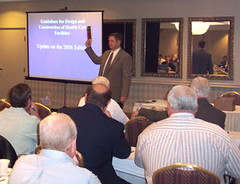
The Director of KTH Architects provided compelling information on AIA’s new Guidelines for Design and Construction of Health Care Facilities. John Adams not only knows what the changes are, he also knows why they changed them and how the guideline authors arrive at decisions. I had a chance to talk to John about one of those changes, the move to design all new patients rooms as single bed. According to John there are several reasons for this change:
  • reduce nosocomial infections
  • patient comfort
  • HIPPA/privacy concerns

It is encouraging to see guidelines that recognize the relationship between Hospital Acquired Infections (HAI) and a hospital’s design. As John explained, decisions are based upon scientific literature. It in incumbent upon entities such as VIGILAIR® to provide the AIA with the growing body of evidence that links air quality and infection transmission. The AIA wants to make timely recommendations and is strongly considering instituting periodic findings to address emerging problems. Wholesale guideline reviews will continue on a four year cycle.

PSHFE President Jim Kelley presented several awards to delegates and reviewed the group’s improving fiscal health.


So you arrive at the hospital that you work at one day. Patients are lined-up out the ED’s door. 70 of them need ventilators. You have ten. You need extra staff, but 1/3 of your workers cannot or will not report to work. What do you do?

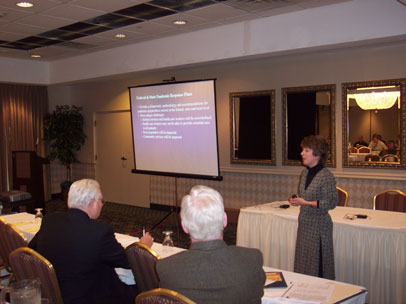
That was the question poised by Melissa Speck, the Director of Policy Development at the Hospital & Healthsystem Association of Pennsylvania (HAP). Ms. Speck focused on the issues hospitals face should a pandemic strike. Then she broadened to topic to include any emergency incident that causes the need for surge capacity. Ms. Speck was careful to stress preparation, rather than panic in such situations. She urged delegates to become involved in planning and warned them not to expect the Federal government to come to the rescue. Following her presentation, she spoke to my colleague and me at our display booth. Ms. Speck seemed particularly interested in the fact that several of our Pennsylvania VIGILAIR® installations were funded by HERSA grants.

A quick recognition of the other vendors who were working hard:


Rachel and Len from Hayes Large Architects.

Jennifer who teamed-up with John Adams to represent KTH Architects.


The always outgoing Leslie (sadly, mostly hidden in this shot) and her colleague James kept things interesting throughout the
conference.


Here's Tom Leach (VIGLAIR System's NYC Sale Representative) at our booth chatting with Tim Robb.

This conference featured excellent speakers and interesting people. I'm certain that next year's conference will be even better!