Showing posts with label hospital design. Show all posts

Wednesday, May 07, 2008

Pilot study reinforces use of portable anteroom HEPA filtration

A new study from a leader in airborne disease research indicates that Operating Room HEPA filtration is not a guarantee against nosocomial infection. Dr. Russel Olmstead led a team that looked at airborne contamination inside of the OR environment.

Pilot study reinforces use of portable anteroom HEPA filtration

To prevent perioperative transmission of airborne microorganisms

Washington, DC, May 6, 2008 – Amidst an increase in new tuberculosis cases, researchers have begun investigating the effectiveness of new operating room filtration systems designed to protect staff and patients. According to pilot study findings published in the May issue of the American Journal of Infection Control, a supplemental portable anteroom high-efficiency particulate air (PAS- HEPA) filter unit placed outside operating room suites may prevent secondary transmission of airborne microorganisms like Mycobacterium tuberculosis (M. tuberculosis).

“The rate of decline in newly reported tuberculosis cases in the U.S. has slowed,” said lead study investigator Russell N. Olmsted, MPH, CIC, epidemiologist from Saint Joseph Mercy Hospital in Ann Arbor, MI. “This, coupled with the worldwide emergence of even more drug-resistant tuberculosis, reinforces the need for renewed vigilance and surveillance from healthcare professionals. In particular, study results reinforce the need for measures to optimize air particle removal.”

Olmsted and colleagues compared the efficiency of freestanding HEPA filtration units to a new portable anteroom system (PAS)-HEPA combination unit in removing harmful airborne infectious pathogens. Freestanding HEPA units were evaluated in the operating room, while the PAS-HEPA unit was placed outside over the main operating room door. Both smoke plume and non-infectious particles similar in size to M. tuberculosis were used to mimic movement of airborne pathogens within highly pressured environments.

“We observed interruption of normal patterns of airflow with freestanding HEPA units placed inside the operating room,” said Olmsted, adding that instead of being captured by the air-filtration system, smoke plume traveled upward from the operating room table and into the breathing zone of personnel who might be present during a typical surgical procedure.

“This suggests an increased potential for occupational exposure to airborne microorganisms as well as an unwanted introduction of contaminants into the patient’s open surgical site,” he explained.

In contrast, deployment of the PAS-HEPA combination unit pulled the smoke downward, away from the operating room table and toward the floor and main door. The second phase of the study (which involved simulated microscopic particles) mirrored these observations; within 20 minutes, over 94% of submicron particles were cleared from the operating room.

“The results of Mr. Olmsted’s study reinforce the Centers for Disease Control and Prevention (CDC) 2003 guidelines for environmental infection control as well as 2005 guidelines for preventing the transmission of M. tuberculosis in healthcare settings,” said Janet E. Frain, RN, CIC, CPHQ, CPHRM, APIC 2008 President and Director, Integrated Services, Sutter Medical Center in Sacramento, CA. “These findings should be considered for integration into an overall infection prevention and control program to help ensure both patient and healthcare personnel safety.”


These findings substantiate results we've discovered in our testing of Operating Rooms. Recently we found microbial contamination (including fungi) immediately downstream from HEPA filtration units installed in ORs. The contamination was found one week after the filters were certified for efficiency compliance.
Filters are great for trapping microorganisms, but they do not 'kill'. Eventually filters can become colonized and act as a breeding ground for pathogens. Thinking that you have 100% protection because you have HEPA filtration is a false sense of security.
We suggest a balance between UV and filtration to provide a better strategy for reducing environmental pathogens in critical care areas of your hospital. E-mail us to find out more about a recent study in which VIGILAIR provided better protection than laminar flow for operating suites in a large urban hospital.

Wednesday, March 12, 2008

Study: MRSA Screening Fails to Lower Infection Rates

A new study published in the Journal of the American Medical Association says that universal MRSA screening upon admission to a hospital may not lead to fewer MRSA infections. The study compared two sets of surgery patients who received services at a Swiss hospital.

One group of more than 10,000 patients were screened for MRSA prior to surgery. If they tested positive for MRSA they were isolated and treated with disinfectant and antibiotics. The control group was of similar size and was not screened. Results from the study show no significant differences in the infection rates between the two groups.

From the Chicago Tribune:

"This is what we've been saying all long," said Kathy Warye, chief executive officer of the Association for Professionals in Infection Control and Epidemiology, a group that opposes efforts to mandate MRSA testing.

While screening patients can be a valuable, it's not a "magic wand" and it's not always the best way to deploy a medical institution's resources, said Dr. Stephen Weber, director of infection control at the University of Chicago Hospitals

Critics of the report's findings say the study may've overlooked some pre-existing MRSA reservoirs:

"Dr. Barry Farr, a MRSA expert, noted the Swiss hospital didn't screen patients on medical wards, who probably served as a reservoir of MRSA infections within the institution and skewed the study's results.

About one-third of surgery patients at the Swiss hospital had surgery before measures could be taken to control potential MRSA infections; that may have contributed to the findings, said Dr. Karen Kaul, chair of molecular pathology at Evanston Northwestern Healthcare."

Responses from both sides (pro and con) augment a central argument in VIGILAIR's infection control (IC) strategy.

  • We believe that IC is dynamic and multifaceted
  • There is no one strategy to eliminate infection
  • There are many reservoirs of infection including patients, healthcare workers and the environment
  • A prudent IC policy attacks pathogen reservoirs on several fronts simultaneously; bundling strategies works best

So, Now What?

MRSA screening has resulted in significant benefit for other facilities, notably Scandinavian hospitals that have virtually eliminated nosocomial MRSA infection after implementing 100% screening upon admission. This new study is not enough justification for a wholesale discrediting of MRSA screening. It is, however, more evidence that IC is more like a web than a chain. Breaking one link of transmission rarely does the trick.

Thursday, February 14, 2008

Killer in the NICU

From my adopted college town of Manchester, the sad story of a NICU death likely caused by airborne aspergillus:

"Baby ward hit by fatal infection
A Greater Manchester hospital has temporarily closed its neo-natal unit after a baby died and another suffered a potentially fatal infection.

A premature baby developed an infection from aspergillus, a common airborne fungus, and died in December at Salford Royal Hospital.

A second pre-term baby tested positive for skin aspergillus last week.

The hospital said it had closed the ward as a precaution to establish any "common contributory factors".

The aspergillus fungus is very common and can be found in homes and buildings everywhere, but can cause infections."

Many studies have shown that aspergillus is ubiquitous in the environment. Healthy people can be exposed to it without serious consequences. That is not true for immune compromised patients in ICU areas. So, what to do about it?

How about filtering the air? Hospitals already do that and yet aspergillus persists. How about letting in more fresh air? This strategy will introduce more and potentially different types of aspergillus into the hospital. What about cleaning the HVAC frequently to get rid of pathogens?

Studies have shown that traditional cleaning is not effective, as this report(1) from the ECMM shows:

"It appears that fungal spores are not necessarily removed by cleaning the fans. Even scratching and painting them, to eliminate rust and restore a smooth surface on which fungal spores cannot be retained, does not permit decontamination."

In fact, servicing the HVAC can exacerbate the problem(2):

"Our observations suggest that localized, short-term exposures resulting from disturbance of (aspergillus) reservoirs are comparable to or may even greatly exceed maximum expected routine exposures. Further, these reservoirs may be disturbed not just during construction or renovation, but even during routine maintenance activities (telecommunications cabling, HVAC filter replacement) that require access to ceiling spaces."

It is clear that the unique needs of ICU areas need unique solutions. That's where VIGILAIR® comes in. VIGILAIR® Systems combine filtration and the germicidal effect of UVC. Rather than just trapping aspergillus spores, VIGILAIR® is designed to provide enough UVC exposure (dose) to destroy aspergillus. UV technology disinfects HVAC surfaces and then keeps those areas clean by continuously radiating the reservoirs where microorganisms can thrive.

Once again, we need to be aware than Infection Control is an environmental issue. Diligent IC professionals must recognize and remove all reservoirs for pathogen growth within the hospital. Unfortunately, the HVAC system is frequently overlooked as a reservoir despite the fact that it houses the largest untreated water supply within a health care facility.

1. European Confederation of Medical Mycology Conference 1996. S. Heinemann, G. Van. houte, N. Nolard. Contamination of indoor environment and air conditioning.
2. European Confederation of Medical Mycology Conference 2008. Khan M, Gonsoulin T, Simpson S, Horner WE. Exposure levels of aspergillus fumigatus from various indoor reservoirs in health care facilities.

Friday, February 08, 2008

Echos in the media

It is encouraging to see response from the press over the recent report on hand washing and infection control. The argument that infection control is dynamic and environmental is being heard in the media, and from APIC! See the recent article from US News and World Reports:

Wringing Our Hands Over Infection Control

February 07, 2008 05:19 PM ET | Avery Comarow |
A number of thoughtful comments arrived concerning my January 23 hand-washing post, about a study showing that a much-increased rate of hand-washing is no guarantee that a hospital's infection rate will budge, let alone dive. A couple of correspondents (notably anesthesiologist-blogger Counting Sheep and hospital-CEO-blogger Paul Levy of "Running a Hospital") contributed thoughts that might prevent a few infections here and there.


The following came as a real letter, if also as an E-mail attachment, from Kathy Warye, another CEO. She runs the Association for Professionals in Infection Control and Epidemiology, whose obvious interest in this subject makes her note very welcome.


"Mr. Comarow makes a critical point that even the single most effective intervention (in this instance, hand hygiene) alone can't solve the problem of healthcare-associated infections. Certainly, even the best hand hygiene compliance only gets us so far.

Lessons learned from our 12,000 members who manage infection prevention programs in healthcare facilities around the world tell us that to reduce the risk of infection and protect people coming into hospitals means adopting a full range of strategies. The first step, from a facility-wide perspective, is conducting a proper risk assessment. Good infection prevention and control professionals don't just know their patients—they know their hospital, they know which areas are at high risk and where there may be hidden reservoirs of bacteria, be it the ER or the OR.


System-wide adoption of proper hand hygiene, contact precautions including use of gloves and gowns, and the "checklist" for device-related care that is receiving so much attention of late are among the tools known to be effective in preventing healthcare-associated infections."


Amen! The single largest source of untreated water in any hospital is its HVAC system. For Critical Care Units aerving the most immune compromised patients, we must eliminate the HVAC as a reservior for pathogens. While VIGILAIR is not a panacea, neither is washing hands. Our technology needs to complement other technologies and institutional efforts for infection control.

Tuesday, January 29, 2008

Hand washing just one part of infection control, medical experts say

An excellent common sense approach to the hype surrounding hand washing hygiene. This article is excerpted from the Grand Island Independent, a newspaper published in Nebraska:


"Widespread use of antibacterial hand gels has helped make it easier for healthcare workers to comply with hand hygiene policies, which is especially important during cold and flu season.

The gels, which have been proven as effective at killing germs as soap and water, are also less drying to the skin an important quality for those who work in the medical field and may cleanse their hands up to 50 times per day.

Recent studies and local experience have proven, however, that increasing compliance to hand-washing policies is not always enough to reduce the rates of hospital-acquired infections.

A study published by the University of Nebraska Medical Center this month showed that while use of antibacterial hand gels in two UNMC adult intensive care units helped the units increase their hand-washing rate from 38 percent to 70 percent, there was no corresponding reduction in hospital-acquired infections.

But a similar experiment at St. Francis Medical Center has had different results.

At St. Francis, the use of hand sanitizer and the creation of a hand hygiene improvement committee has nearly doubled the rate of hand-washing policy compliance for the entire hospital, said Laura Mader, St. Francis infection control coordinator.

The hospital's current 76 percent compliance rate is above the national average. It has also led to a decrease in St. Francis' incidence of hospital-acquired infections, Mader said.

While UNMC and St. Francis had different results in similar experiments, officials from both facilities agree that hand washing, while highly important, is only one component of infection control.

"There are many factors that influence the development of hospital-acquired infection," said Dr. Mark Rupp, professor of infectious diseases at UNMC. "It would be naive to think that a single, simple intervention would fix this problem."

The lack of a correlation between increased hand hygiene and lower incidence of infections could be attributed to many factors, including UNMC's already low infection rate in the ICU."

Infection Control professionals fight disease transmission on many fronts. While hand washing has drawn much attention, it is merely one weapon in the arsenal. We believe that a comprehensive approach to infection control should include air disinfection, especially in critical care units.

Sunday, January 20, 2008

ASHRAE Meeting off to great start

It's cold here in New York City as the annual winter meeting ASHRAE lives up to its name. With so many forums to attend, where do you begin.
This morning we attended an excellent seminar titled, "Hazardous Biological Agents in Hospital Air: When the HVAC Plant exacerbates rather than mitigates against HAI". Dr. Bob Scheir of Steril-Aire led the discussion on why Health Care Facilities pose unique challenges to HVAC engineers. The seminar was well attended reflecting the increased interest in airborne transmission of disease.
Tim Keane, a consulting engineer to Health Care clients, talked about the importance of maintenance programs, and how simple measurements can indicate if your system is fouled by microorganisms.
William McCoy, PhD of the life sciences company Phigenics, focused on Legionella in the Health Care setting. Dr. McCoy enlightened us on the unique relationship between protozoa and legionella. He also said that while our understanding of this pathogen has increased, much more research needs to be done.
The afternoon was spent in a lively technical meeting (TC 9.6-the subcommittee on Infectious Diseases). A spirited discussion ensued, led by Mike Keen. While much ground was covered, the meeting also highlighted how much more science is needed. But the good news is that the engineering community is starting to accept the idea that HVAC can prevent/cause nosocomial infection. The seminar was a good mix of experienced members and many younger engineers who are interested in this emerging topic.
That's all for tonight!

Thursday, August 23, 2007

UK University Leeds the way in Airborne Infection Research

Some of the most compelling and important research in airborne contamination control originates from a progressive university in the resilient city of Leeds. Known as a manufacturing center (or is it centre?), Leeds has managed to diversify itself, evolving into a hub for international banking and business services.

Researchers at the University of Leeds are proving that hospital design plays a major role in healthcare, specifically the growing problem of hospital acquired infections. Perhaps the key to their success is an understanding of the role that the indoor environment plays in disease transmission. According to Leeds professor Andrew Sleigh, “There is evidence that 10 to 20% of infections are spread through the air, but until now, their role in the infection chain has been largely overlooked, as doctors tend to emphasise the importance of washing hands and avoiding physical contact.” I guess being open to new ideas can lead to new discoveries.

Another key could be the University’s cross-disciplinary approach to learning. Leeds University prides itself on innovative study programs that give students creative options:

“Many of its research initiatives cross traditional subject boundaries and Leeds currently promotes projects through 58 inter-disciplinary centres and seven research schools.”

This approach is apparent in the Pathogen Control Engineering Research Group within Leeds’ School of Civil Engineering:

"Our multi-discipline approach brings together investigators from a variety of backgrounds including public health engineering , fluid mechanics , building services engineering and microbiology . This has produced a team with the all-round strengths required to undertake rigorous research in the field of aerobiology and indoor air quality.

Leeds’ advances demonstrate both the challenge and the promise of airborne infection research. Research in this field requires the talents and intelligence of participants from several disciplines. This approach was taken by scientists who reviewed research papers published between 1960 and 2005 on airborne disease transmission (1). More than 200 papers were assessed by a team of 15 experts in epidemiology, virology, environmental health and engineering. This study, and the work at Leeds, shows that greatest discoveries are found at the nexus of divergent technologies.

Recent Leeds Research

Although not entirely complete, Leeds researchers released some results from recent airborne pathogen testing. According to Professor Sleigh's research, infectious particles are distributed within hospital wards.

“Although diseases such as tuberculosis are widely accepted as being airborne, others may also be spread this way. Numerous bacteria-carrying particles - such as tiny flakes of human skin - can be widely dispersed into the air within hospital wards through routine activities, and potentially contribute to the risk of infection for patients.”

PhD students Abigail Hathway and Katherine Roberts used a laser counter to assess the particle concentration of hospital ward air. Their data indicate that normal staff operations such as making rounds, closing drapes and changing patient beds significantly affected concentrations of airborne particles.

These findings add important new insight to the role of the airborne route in infection transmission. This research will be used by the UK’s National Health Service to update guidelines for ventilation and infection control. According to Ms. Hathaway, more research will be done in the upcoming months, with an eye on possible publication in 2008.

Diverse curriculum, public-academic partnerships and accomplished professors are among the reasons why Leeds attracts more undergraduate applications than any other UK university. Plus, any school that Mark Knopfler attended has got to be way cool!

1. Li Y, et al. Role of ventilation in airborne transmission of infectious agents in the built environment—a multidisciplinary systematic review. Indoor Air 2007; 17: 2-18.

Monday, March 12, 2007

A meeting of creative minds

I was privileged last week to attend the evidence based design and a passion for improving the environment of care in health facilities world wide. The Center is known for matching new design technology with progressive hospital administrators who are looking for innovative ways to improve patient care.
Environment Standards Committee (ESC) members volunteer their time to bring evidence based ‘best practices’ to such organizations such as the American Institute of Architects (AIA).
ESC members tend to be recognized leaders in architecture and design who are simultaneously extremely creative and pragmatic. They marry their expertise with a hunger for innovation to produce solutions that are aesthetically, environmentally and economically beneficial.
Following the meeting, we were given a tour of the building. Richard Smith was kind enough to show us the newly designed structure of 1305 York Avenue, a part of the Weill Cornell Medical College. Mr. Smith demonstrated how attention to design details have yielded a significantly better care experience for patients who receive ambulatory outpatient services here.
Many of the innovations stemmed from a patient survey that highlighted patient perceptions about care. Changes in design to floor plans and internal procedures have produced a streamlined admissions process that reduces waiting time, assures HIPPA privacy and eliminates paper records. It would be difficult to review all the innovations of this building, so I will share some images of the tour.


Center For Health Design

Sunday, October 29, 2006

Highlights of Healthcare Conference in Harrisburg

The Pennsylvania Society of Healthcare Facility Engineers (PSHFE) chose to meet in Harrisburg, PA this past week, and I think I know why. The region is exploding with autumn colors this time of year, especially as you approach from the north, as I did. The vivid leaves contrasted the dark shades of the mountains, the granites and limestones that thrust skyward in this region. If the light is right the Susquehanna River provides a pastel mirror of the scene as it leads you to Harrisburg, the commonwealth’s capitol.

The day long conference brings together professionals who are prime audience for VIGILAIR Systems, Inc. Attendees tend to be progressive and active men and women who manage the physical plants of regional hospitals. Among the participants were several current customers who have VIGILAIR® installed inside their facilities.

The conference’s first speaker provided an update on the ‘Environment of Care.’ Michael Rudolf explained changes in JACHO programs, how to prepare for a survey and how to respond should you face a ‘Recommendation For Improvement’. Mike proved to be one of the most thoroughly prepared and well researched presenters I’ve heard in a long time. He is the Director of Improvement Services for VHA East Coast.

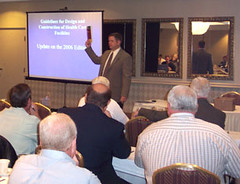
The Director of KTH Architects provided compelling information on AIA’s new Guidelines for Design and Construction of Health Care Facilities. John Adams not only knows what the changes are, he also knows why they changed them and how the guideline authors arrive at decisions. I had a chance to talk to John about one of those changes, the move to design all new patients rooms as single bed. According to John there are several reasons for this change:
  • reduce nosocomial infections
  • patient comfort
  • HIPPA/privacy concerns

It is encouraging to see guidelines that recognize the relationship between Hospital Acquired Infections (HAI) and a hospital’s design. As John explained, decisions are based upon scientific literature. It in incumbent upon entities such as VIGILAIR® to provide the AIA with the growing body of evidence that links air quality and infection transmission. The AIA wants to make timely recommendations and is strongly considering instituting periodic findings to address emerging problems. Wholesale guideline reviews will continue on a four year cycle.

PSHFE President Jim Kelley presented several awards to delegates and reviewed the group’s improving fiscal health.


So you arrive at the hospital that you work at one day. Patients are lined-up out the ED’s door. 70 of them need ventilators. You have ten. You need extra staff, but 1/3 of your workers cannot or will not report to work. What do you do?

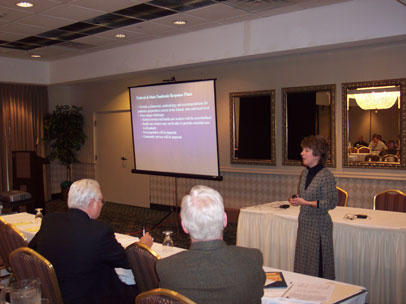
That was the question poised by Melissa Speck, the Director of Policy Development at the Hospital & Healthsystem Association of Pennsylvania (HAP). Ms. Speck focused on the issues hospitals face should a pandemic strike. Then she broadened to topic to include any emergency incident that causes the need for surge capacity. Ms. Speck was careful to stress preparation, rather than panic in such situations. She urged delegates to become involved in planning and warned them not to expect the Federal government to come to the rescue. Following her presentation, she spoke to my colleague and me at our display booth. Ms. Speck seemed particularly interested in the fact that several of our Pennsylvania VIGILAIR® installations were funded by HERSA grants.

A quick recognition of the other vendors who were working hard:


Rachel and Len from Hayes Large Architects.

Jennifer who teamed-up with John Adams to represent KTH Architects.


The always outgoing Leslie (sadly, mostly hidden in this shot) and her colleague James kept things interesting throughout the
conference.


Here's Tom Leach (VIGLAIR System's NYC Sale Representative) at our booth chatting with Tim Robb.

This conference featured excellent speakers and interesting people. I'm certain that next year's conference will be even better!