Monday, March 12, 2007

A meeting of creative minds

I was privileged last week to attend the evidence based design and a passion for improving the environment of care in health facilities world wide. The Center is known for matching new design technology with progressive hospital administrators who are looking for innovative ways to improve patient care.
Environment Standards Committee (ESC) members volunteer their time to bring evidence based ‘best practices’ to such organizations such as the American Institute of Architects (AIA).
ESC members tend to be recognized leaders in architecture and design who are simultaneously extremely creative and pragmatic. They marry their expertise with a hunger for innovation to produce solutions that are aesthetically, environmentally and economically beneficial.
Following the meeting, we were given a tour of the building. Richard Smith was kind enough to show us the newly designed structure of 1305 York Avenue, a part of the Weill Cornell Medical College. Mr. Smith demonstrated how attention to design details have yielded a significantly better care experience for patients who receive ambulatory outpatient services here.
Many of the innovations stemmed from a patient survey that highlighted patient perceptions about care. Changes in design to floor plans and internal procedures have produced a streamlined admissions process that reduces waiting time, assures HIPPA privacy and eliminates paper records. It would be difficult to review all the innovations of this building, so I will share some images of the tour.


Center For Health Design

Monday, February 26, 2007

Healthcare takes a new look at airborne pathogens


The concept of airborne disease transmission was well accepted in the early to mid 1900's. It was frequent that you would see UV lights in hospital wards for upper air disinfection. UV lights were a standard form of infection control in TB wards.
But then times changed. Aggressive measures helped to eradicate TB from our country. Drugs such as vaccines proved effective and immediate. Hospitals, like all buildings, began to have ventilation to exhaust contaminated air while bringing in fresh air. Scientists and researchers turned away from studying airborne transmission and moved on to newer issues.
Since the advent of SARS, pandemic influenza and a resurgence in TB, scientists are once again turning their attention to airborne transmission. We've prepared a new white paper that examines some of the findings of these new studies. Like all good research it answers some questions and raises some more! Hopefully this spark new interest in studying airborne transmission.

Friday, February 23, 2007

UV Destroys DNA in a Flash!


Readers here know that we discuss the germicidal aspects of Ultraviolet Irradiation. We know that a specific wavelength of UV damages a microorganism's DNA, which neutralizes the pathogen. We also know that UV does this pretty quickly from lab experiments and published papers. But now we know just how fast it takes.
Researchers have now clocked the effects of UV on DNA in real time. It turns out UV does its work in less than a picosecond.
For more on what a picosecond is, and what this development means to scientist, check out this link to Science A-go-go. It's a great site for science with a little twist!

Wednesday, February 07, 2007

South Africa Fights XDR-TB with UVGI

Multi and Extreme Drug Resistrant TB strains are ravaging parts of Africa, mainly preying upon HIV+ patients whose immune systems are weakened. While TB was nearly eradicated from Western countries, it is a serioud health threat elsewhere, especially in South Africa.
Because TB is airborne, UVGI systems are an effective way to stop transmission of the disease. The article below mentions how UV is used in a new TB unit in a hospital about 2 hours north of Pretoria.
The Minister of Health, Dr Manto Tshabalala-Msimang and Limpopo Health MEC Seaparo Sekoati visited a newly upgraded Tuberculosis (TB) unit at the FH Odendaal Hospital in the town of Modimolle in Limpopo today.
The visit comes after the Department of Health spent about R2, 5 million to upgrade the unit to accommodate more drug-resistant TB patients.

The unit is designed to prevent hospital acquired TB infection and improves patient care and treatment outcomes.

The hospital has 38 beds, 17 Multi-Drug (MDR) TB patients and three Extreme Drug Resistant (XDR) TB patients are accommodated in the hospital.

The unit is fitted with extractor fans and ultraviolet light filters which remove and kill bacteria and thereby prevent cross infection in the hospital.

"For extra protection, respirator masks are issued to all health workers and visitors in the hospital and patients are provided with surgical masks," Dr Tshabalala-Msimang.

She said MDR TB Units are being improved countrywide to deal with infection control.
UV systems were routinely used in this country to treat TB, starting in the 1930's. As more effective drugs were crafted, and TB's threat waned in the US, so did the use of UV in hospitals. It now appears that UV technology is once again needed to help stop the TB killer from spreading.

Thursday, February 01, 2007

US Military Magazine Reviews UVGI


Arthur S. Hughes knows a thing or two about terrorism, national security and airborne pathogens. To start, he served in the Navy during the Vietnam era. Now he is a Master Sergeant in the National Guard's 128th Chemical Company and is a PA (Physician's Assistant). In his civilian life he works for the New Jersey Department of Environmental Protection.

So, when it comes to biodefense, he's got the credentials!

In the most recent issue of the journal Army Chemical Review, Master Sergeant Hughes provide a neat overview of what Ultraviolet Germicidal Irradiation (UVGI) is, and how it can help protect buildings from attack. To read the article, click here.

To find archive issues of Army Chemical Review,
click here.

In researching this article, I discovered that the Army has several publications that are available for us civilians. The list is extensive and interesting, whether you're researching the latest in defense technology or interested in military history. In typical Army creative style, the library is called the Army Professional Writing Collection and can be found here.

Monday, January 22, 2007

A New Flu View

Here’s an update of avian influenza from around the globe:
  • Indonesia reported its 62nd avian flu fatality last week. Only 18 Indonesians who have contracted the disease survived.
  • Of the 19 confirmed cases of avian flu in Egypt, 11 have been fatal. An Egyptian woman who had exposure to sick and dead poultry became the 19th fatality last week.
  • Vietnam has suffered the greatest number of H5N1 infections. To date 93 people in that country contracted avian flu, resulting in 42 deaths
  • Other countries with reported avian deaths include China, Cambodia Thailand, Turkey and Iraq.

Another excellent way to get a snap shot of avian influenza as it develops is on Google Earth. Researchers have created an excellent map of bird and human outbreaks. In order to view the map, you need to have Google Earth installed on your PC. The map overlays for avian flu are available here.

Monday, January 15, 2007

UV 911

From the Journal of Emergency Medical Services, word of an excellent application of UV—disinfection of ambulance interiors.

UV’s germicidal action makes it a perfect tool to sanitize the surfaces in an ambulance. After all, ambulance crews are our first responders and are likely to transport ill people in the case of an epidemic or pandemic. The article notes that UV-C is more effective on deactivating viruses than chlorine.

The article points out many of UV's benefits:

“UV-C lights have many advantages. They're environmentally friendly with no dangerous materials to handle or store, so employees won't need to handle any toxic chemicals. The lights are also immediately effective, economical and operator friendly. (Just flip a switch.) Maintenance is easy—periodic cleaning and annual lamp replacement should do it. Installation involves only simple wiring, timer switches and a power connection.”

Check out the complete article by clicking here. Although we do not design such application, the principle is the same for VIGILAIR HVAC protection systems.

Thursday, January 11, 2007

Video Shows Iraqi Insurgents Firing Chemical Rockets


A video that surfaced on the internet today appears to show Iraqi Insurgents arming and firing chemical rockets. The minute long video ends with four of the alleged 'chemical' rockets being fired from a makeshift launcher. Is is just propaganda, or a legitimate video? So far there has been no independent confirmation of the attack. The rockets are believed to have been launched in the Samarra region of Iraq, which is about 124 kilometers north of Baghdad. Samarra was used as the primary facility for producing mustard gas and nerve agents during the Saddam Hussein regime, according to Iraqwatch.org.
Should this attack prove legitimate, it raises concerns that such chemical weapons could be used more widely in Iraq, and elsewhere. We will keep you posted on this developing story!

Tuesday, November 21, 2006

Editorial-Pennsylvania's Infection Reporting

Here is an open letter to the editor about the mandatory reporting of HAI's in Pennsylvania hospitals. It accurately reflects our feelings on the issue:


Editor,

Pennsylvania has a rich history of trail blazing in healthcare. The first medical school in America opened in our state in 1765. The first medical school for female students opened here as well, in 1850.

Building on this history of innovation, Pennsylvania is the first state to mandate thorough public reporting of hospital acquired infections (HAIs) for all hospitals within the Commonwealth. Now that the first year’s worth of results are published, hospital officials are justifiably concerned that people will misinterpret the information. As a person who works with hospitals in Pennsylvania to reduce HAIs, I understand their unease.

Under the current reporting rules:

-some honest hospitals that scrutinize and report all HAIs may face an unfavorable comparison with hospitals that are not as diligent in their reporting.

-the types of infections that hospitals were mandated to track changed during the year; these rule changes may’ve caused errors and confusion.

-mortality rates are skewed for hospitals that provide palliative care for terminally ill patients who, by request, do not seek aggressive interventions.

In the hospitals’ defense, defining the source of an infection can be elusive.

Difficulty in finding an infection’s source is reflected in a study published in the November 2006 issue of the American Journal of Infection Control. Researchers reviewed medical reports of more than 1,500 outbreaks of HAIs. In 37% of the outbreaks no source could be identified.

Where does this leave Pennsylvania healthcare consumers? The answer is that we are in a better position than any other state to monitor and improve the quality of medical care. Here are some things to keep in mind as you review the new statistics on HAIs:

-knowledge is power! Some measure of quality is better than none. HAI statistics are certain to evolve with time and become clearer and fairer.

-HAI rates are just one indicator of quality. Speak to your physician, or better yet, speak to a nurse who works in a hospital you’re considering for a procedure. Another great source of hospital information is available on the web through the Joint Commission on Accreditation of Healthcare Organizations (www.jointcommission.org).

-all healthcare is local. Many effective hygiene techniques occur right inside your hospital room. Thanks to HAI awareness, you can prevent infections by insisting on rigorous adherence to hand washing procedures (don’t be shy about asking physicians, nurses and visitors to wash their hands).

In Pennsylvania we should be proud that we are able to gather and view information on HAIs. In many other states political pressure has prevented citizens from having access to this important data. We must be aware that infection control is dynamic—numbers can only tell part of the story. But at least we are telling the story here in Pennsylvania and we are beginning a dialogue on how to break the chain of pathogen transmission within hospitals.

Once again Pennsylvania is a pioneer in healthcare.

Sunday, October 29, 2006

Highlights of Healthcare Conference in Harrisburg

The Pennsylvania Society of Healthcare Facility Engineers (PSHFE) chose to meet in Harrisburg, PA this past week, and I think I know why. The region is exploding with autumn colors this time of year, especially as you approach from the north, as I did. The vivid leaves contrasted the dark shades of the mountains, the granites and limestones that thrust skyward in this region. If the light is right the Susquehanna River provides a pastel mirror of the scene as it leads you to Harrisburg, the commonwealth’s capitol.

The day long conference brings together professionals who are prime audience for VIGILAIR Systems, Inc. Attendees tend to be progressive and active men and women who manage the physical plants of regional hospitals. Among the participants were several current customers who have VIGILAIR® installed inside their facilities.

The conference’s first speaker provided an update on the ‘Environment of Care.’ Michael Rudolf explained changes in JACHO programs, how to prepare for a survey and how to respond should you face a ‘Recommendation For Improvement’. Mike proved to be one of the most thoroughly prepared and well researched presenters I’ve heard in a long time. He is the Director of Improvement Services for VHA East Coast.

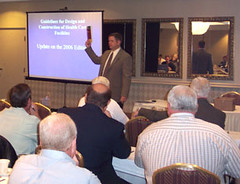
The Director of KTH Architects provided compelling information on AIA’s new Guidelines for Design and Construction of Health Care Facilities. John Adams not only knows what the changes are, he also knows why they changed them and how the guideline authors arrive at decisions. I had a chance to talk to John about one of those changes, the move to design all new patients rooms as single bed. According to John there are several reasons for this change:
  • reduce nosocomial infections
  • patient comfort
  • HIPPA/privacy concerns

It is encouraging to see guidelines that recognize the relationship between Hospital Acquired Infections (HAI) and a hospital’s design. As John explained, decisions are based upon scientific literature. It in incumbent upon entities such as VIGILAIR® to provide the AIA with the growing body of evidence that links air quality and infection transmission. The AIA wants to make timely recommendations and is strongly considering instituting periodic findings to address emerging problems. Wholesale guideline reviews will continue on a four year cycle.

PSHFE President Jim Kelley presented several awards to delegates and reviewed the group’s improving fiscal health.


So you arrive at the hospital that you work at one day. Patients are lined-up out the ED’s door. 70 of them need ventilators. You have ten. You need extra staff, but 1/3 of your workers cannot or will not report to work. What do you do?

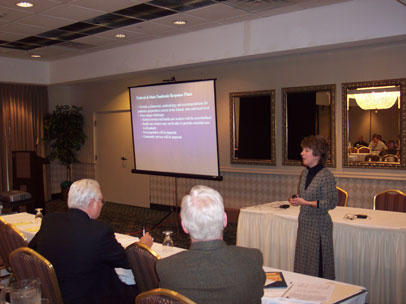
That was the question poised by Melissa Speck, the Director of Policy Development at the Hospital & Healthsystem Association of Pennsylvania (HAP). Ms. Speck focused on the issues hospitals face should a pandemic strike. Then she broadened to topic to include any emergency incident that causes the need for surge capacity. Ms. Speck was careful to stress preparation, rather than panic in such situations. She urged delegates to become involved in planning and warned them not to expect the Federal government to come to the rescue. Following her presentation, she spoke to my colleague and me at our display booth. Ms. Speck seemed particularly interested in the fact that several of our Pennsylvania VIGILAIR® installations were funded by HERSA grants.

A quick recognition of the other vendors who were working hard:


Rachel and Len from Hayes Large Architects.

Jennifer who teamed-up with John Adams to represent KTH Architects.


The always outgoing Leslie (sadly, mostly hidden in this shot) and her colleague James kept things interesting throughout the
conference.


Here's Tom Leach (VIGLAIR System's NYC Sale Representative) at our booth chatting with Tim Robb.

This conference featured excellent speakers and interesting people. I'm certain that next year's conference will be even better!

Tuesday, October 24, 2006

It is nice to be recognized

Not me, my boss!
The CEO of my company was recognized by a prestigious trade journal to be the key speaker for an on-line forum on infection control.
The magazine, Faciltity Care, is well respected by those of us who market technology to the healthcare sector. Tim, our CEO, will discuss various aspects of aerosols and airborne infection. The forum is a 2-way discussion so I'm certain that he will take questions from the audience on UVGI and its application in the HVAC system of hospitals.
For more information on the forum, click here.

Tuesday, September 26, 2006

Financing the global village’s healthcare. Are we doing enough?

Health economist Ruth Levine (a member of the think tank Center for Global Development) makes an interesting analogy in a recent essay entitled, “A Cure for the Asian Flu.” In the article Ms. Levine notes the global response to economic crises in third world and emerging nations. In this world economy, when Asia sneezes. Wall Street can quickly get a cold.
When these situations arise the US, World Bank, IMF and other entities are there to lend financial support. Ms. Levine’s premise is that such interventions are not charity, but preventive medicines to isolate and ‘cure’ an ailing economy before the red ink washes upon our shores.
The essay proposes that we treat global health problems as we do global financial problems and drastically increase aid. Ms. Levine suggests that spending more on health care for developing nations will act as an investment that keeps such problems away from us.
Agreed. Better healthcare in China equals better healthcare in the West–remember SARS? But redistributing wealth on a grand scale to achieve this goal is not the sole answer. Let’s look at AIDS as a global health problem.
AIDS awareness spending is higher than ever. Few Americans (3% in a recent poll) know that the Bush administration has pledged $15 billion to fight HIV over a five year period ($8.4 billion has already been spent). AIDS is not a new issue, and it must be assumed that most people in the world are aware of what it is and how to prevent it. The good news is that with increased spending we’ve seen HIV infection rates decrease or stabilize for the most part. But despite all the awareness and spending, 40,000 Americans become infected with HIV each year. World wide 14,000 new HIV infections happen everyday, totaling 5 million new HIV infections each year. Money is part of the solution, but not the only solution for this problem.
Sometimes aid is ineffective, and it is not because the donor countries are not giving enough. Economics Professor William Easterly discusses the issue in his book, The White Man’s Burden; Why the West’s Efforts to Aid the Rest have Done So Much Ill and so Little Good, (Penguin Press, 2006), NY Times book review here.

[A tragedy of the world’s poor has been that] the West spent $2.3 trillion on foreign aid over the last five decades and still had not managed to get twelve-cent medicines to children to prevent half of all malaria deaths. The West spent $2.3 trillion and still had not managed to get four-dollar bed nets to poor families. The West spent $2.3 trillion and still had not managed to get three dollars to each new mother to prevent five million child deaths.

… It is heart-breaking that global society has evolved a highly efficient way to get entertainment to rich adults and children, while it can’t get twelve-cent medicine to dying poor children.
Rational people can agree that more should be done to better the healthcare of all who inhabit this interconnected planet. For altruistic or self-centered reasons, those who are blessed with more should share with those who have less. But it is unfair to characterize the developed world in general and the US in particular as uncaring, short sighted and cheap. In a world of limited resources and seemingly unlimited need it is reasonable that donor countries seed money where it is effectively spent. It is incumbent upon recipient nations to make the most of the funding. Frequently governments and individuals, for political and personal reasons, corrupt the process. If Ms. Levine wants healthcare aid to have the same stipulations (e.g. insistance on positive outcomes) as other aid, then I'm all for it. But it should be done intelligently.
In fighting global health issues donor countries can supply some meager tools. It is up to the recipient countries to build the best systems that they can with those tools. Yes more needs to be done, but it is not from a lack of trying by more developed nations.
As Professor Easterly says in his book, judging the success of aid programs by the amount of money spent is like reviewing hollywood movies based on their budgets.

Monday, September 25, 2006

XDR-TB, S.A. and UVGI


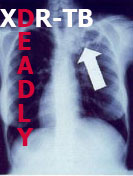
Extensively Drug Resistant TB (XDR-TB) is an emerging killer that is virtually untreatable. World wide, 9 million people contract TB each year, and 1.7 million of them die. Typically TB is treated with first and second line drugs. XDR-TB is resistant to the first line drugs as well as most of the second line drugs. There are no third line drugs for TB at this time. This new strain is found in many countries, including the US. Right now it is preying upon HIV positive patients in South Africa. In one South African ward, 52 of 53 patients infected with XDR-TB died. And they died quickly, within 25 days of diagnosis.

Part of the problem is the nature of South Africa's inadequate health care. 50% of South Africans treated for TB will find themselves back at the hospital again because their treatment failed. The longer these people stay in the hospital, the more likely they are to come in contact with, and contract, XDR-TB. In essesnce, the South African situation appears to be an instance of Hospital Acquired Infection. That's where Ultraviolet Germicidal Irradiation could play a role.

UVGI was a regular method of TB control in the US for many years. Upper room UV deactivates TB and prevents the virulent bacteria from infecting people via the air. As effective drugs were developed, UV fell out of vogue. But UVGI plays a unique role in fighting infectious disease. Virulent viruses and bacteria are programmed to find ways to adapt to medicines that stop them. Over time, drugs lose their effectiveness and contribute to creation of drug resistant microorganisms.

UVGI is a prophylactic barrier. The use of UV radiation to prevent DNA and RNA from being able to replicate is not something that a microorganism can adapt to and circumvent. Of course, certain organisms are more resistant to UV and take a larger dose for inactivation (e.g. spores). However, an organism's suseptibility to UV doesn't change or grow more resistant. Once engineers know the dose needed to inactivate a microorganism, UV systems can be designed with sufficient exposure to get the job done.

So far we are unable to find any reports of the use of UV in South Africa to fight XDR-TB. Given that doctors involved in this crisis say XDR-TB is a nosocomial phenomenon, it would appear that UVGI could help contain a threat that is more immediate and more deadly than exisitng strains of H5N1.

Wednesday, September 13, 2006

Old Flu News is New Again

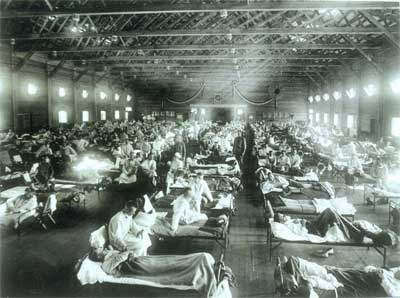
How did Americans deal with the ‘Spanish Influenza’ outbreak during WW I? The following is taken from a memo by the US Army Surgeon General. It appears as if some of these suggestions remain valid to this day:

Memorandum, Surgeon General’s Office, for camp and division surgeons, September 27, 1918. Personal Defense Against Spanish Influenza. It is desired that the following 12 suggestions for avoiding influenza be given all possible publicity in your camp, by placarding and other proper means of bringing it to the attention of the command.

HOW TO STRENGTHEN OUR PERSONAL DEFENSE AGAINST SPANISH INFLUENZA.
  1. Avoid needless crowding; influenza is a crowd disease.
  2. Smother your coughs and sneezes; others do not want the germs which you would throw away.
  3. Your nose, not your mouth, was made to breathe through; get the habit.
  4. Remember the three C’s—a clean mouth, clean skin, and clean clothes.
  5. Try to keep cool when you walk and warm when you ride and sleep.
  6. Open the windows—always at home at night; at the office when practicable.
  7. Food will win the war if you give it a chance; help by choosing and chewing your food well.
  8. Your fate may be in your own hands; wash your hands before eating.
  9. Don’t let the waste products of digestion accumulate; drink a glass or two of water on getting up.
  10. Don’t use a napkin, towel, spoon, fork, glass, or cup which has been used by another person and not washed.
  11. Avoid tight clothes, tight shoes, tight gloves; seek to make nature your ally not your prisoner.
  12. When the air is pure, breathe all of it you can; breathe deeply.
If anyone can tell me the link between infection and tight clothes, please do so. The material above is from Office of the Army Surgeon General, Public Affairs, and the Directorate of Information Management, Fort Detrick, Md. Their web site is quite informative.
Image info: Emergency hospital during influenza epidemic, Camp Funston, Kansas.
Source: National Museum of Health and Medicine

Thursday, September 07, 2006

Avian Flu Fighters use GPS for Wild Swan Chase

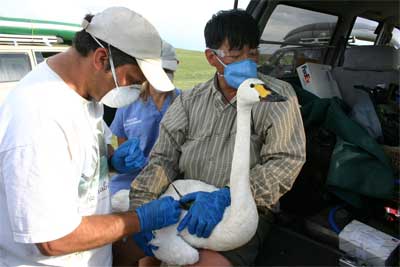
This is tangential to our normal topics, but it's cool to see how man evolves and adapts to evolving threats from nature--namely H5N1. If you think the first image looks like people putting a backpack on a bird, you are correct. Researchers are carefully attaching tiny solar powered GPS sending units to 10 Whooping Swans.
The swans are migrating now from their homes in Mongolia, to their wintering grounds in Europe. The swans' journeys will be mapped by the researchers who are tracking the GPS information transmitted by the tiny GPS units. The hope is that this information will help is better understand the role that migratory birds play in the spread of bird flu.
These swans were chosen for two reasons:
  1. Highly Pathogenic Avian Influenza has alreadybeen found in this bird, so it could be an infection spreader
  2. Thousands of the swans mysteriously died in Mongolia and China in 2005 and 2006 in areas where few chickens are present.
Check out complete information from the scientists involved in the study by clicking here.
The second image shows a swan heading back into the wild with its tiny GPS backpack. The units are designed to eventually fall off the birds after the migration season.
Let's hope that our knowledge continues evolving just as pandemic threats evovle in the world.

Wednesday, September 06, 2006

Hygiene Expert: Reduce Harmful Bacteria by Changing Your Culture!

A novel idea is proposed by Virologist Dr. John Oxford of the Royal London Hospital. Dr. Oxford suggests that governments can change public hygiene behavior by changing public perception. In other words, let’s treat hygiene issues the same way we’ve attacked smoking and seatbelt use.


A coordinated public PR campaign taught in schools and broadcast as PSA’s could change the way people think about hand washing, house keeping and other hygiene issues. Dr. Oxford chairs the Hygiene Council, a think tank that promotes better understanding of the role microorganisms play in infectious disease. The Hygiene Council is funded by Reckitt Benckiser marketers of such brands as Calgon, Lysol, Woolite and Spray-N-Wash.

The Hygiene Council has just conducted a survey of Canadian hygiene practices that found:
  • 36% of respondents did not properly wash hands after sneezing
  • 37% of respondents didn’t wash hands after petting animals
  • 9% of respondents failed to wash their hands after using the restroom

Back to the war on germs. Oxford’s recommendations are an excellent start to reduce infections such as colds and flu. I see it as an important part of disrupting the chain of transmission, an idea that recognizes infectious disease is an environmental issue which includes all modes of transmission.

Wednesday, May 24, 2006

H2H avian flu transmission in Indonesia?

“Tell the truth. Just don’t tell the whole truth,” my AP English teacher said. It seems that The World Health Organization is following this advice in the wake of a recent Avian Flu outbreak in Indonesia.
A woman who worked selling vegetables contracted the H5N1 virus, possibly from live animals that were sold in the market where she worked. She brought the infection home and this resulted in the death of a total of six family members. A seventh family member was able to survive the infection.
In a conservative move the WHO has not explicitly stated that Human to Human (H2H) transmission is at play in this outbreak. Instead WHO said:

“no evidence that efficient human-to-human transmission has occurred”

Many Infectious Disease Professionals are arriving at the conclusion that H2H has occurred, although this transmission has not been efficient. So what’s the big deal? People who monitor H5N1 become suspicious when the WHO tells part of the truth. So when the WHO says genetic sequencing of this Indonesian flu strain shows no significant mutations in the virus, people may be skeptical. Especially since the sequencing is not freely shared with researchers.
The bottom line is that H5N1 has changed in this respect: it appears that people with no direct contact to poultry can become infected with the Avian Flu. This is a new development…or it is new because we are uncovering more of the whole truth?

Tuesday, May 16, 2006

DHS Designates our Biodefense Technology

With as much emotion as engineers and researchers can muster, everyone at our firm celebrated an important achievement last Friday.

We received DHS SAFETY Act Designation!

In order to understand why this was so important to us, you’ll probably need to know what the SAFETY Act is. In 2002 the US Congress passed the Support Anti-Terrorism by Fostering Effective Technologies (SAFETY) Act. The law aimed to help bring anti-terrorism technology to the market place. Law makers were concerned that issues surrounding liability would prevent much needed security technology from being developed and deployed.

The SAFETY Act set predetermined liability limits for the manufacturers and users of Qualified Anti-Terrorism Technologies (QATT) for claims arising out of a terror attack. The SAFETY Act effectively removes many of the barriers facing new defense technologies. As those barriers decrease, adoption of critical infrastructure protection technology increases.

Why are we so happy?
The Designation recognizes all of the exhaustive efforts of our staff. DHS requires comprehensive data during the application process. Once compiled, the application is scrutinized by a group of technical experts empanelled by the DHS.

Our team spent more than 300 man hours in the compiling, writing and submission of the application. The months of hard work paid-off on Friday when we read the words in the letter from DHS Under Secretary Jeffrey Runge:
“I hereby designate the Technology as a Qualified Anti-terrorism Technology and issue a Designation…for the technology.”
We are in good company. Other enterprises that have successfully earned Designation include Lockheed-Martin, Boeing, Northrup-Grumman and IBM. We’re not as large as those companies…at least not yet!

Technorati Tags

Tuesday, May 09, 2006

Bird Flu goes Hollywood

ABC is airing a 2 hour made for TV movie dramatizing the outbreak of a deadly pandemic flu. “Fatal Contact: Bird Flu in America” is certain to start people talking about the pandemic problem, but some health experts are concerned the drama may inaccurately portray the real situation.
In a breaking of precedence, the US Federal Government is prepared for a flood of potential inquiries from Americans who watch the movie. Health and Human Services has issued ‘talking points’ for staff who may encounter bird flu related questions.
While some health care experts are panning the pandemic thriller for hype, tv critics seem to agree it is good television.
The Hollywood report recommends the movie!
Hopefully the movie will cause conversations about the bird flu, and maybe, just maybe it will lead to better understanding of infectious disease. For that reason alone, I would give the effort two thumbs up!

Technorati Tags

Wednesday, May 03, 2006

Ohio Hospital Association

Ohio Hospital Association
We just returned from attending a seminar in Dublin, Ohio (just northwest of Columbus). VIGILAIR Systems was there due to our relationship with the Ohio Hospital Association. More than 100 delegates from across Ohio gathered to learn more about the rigorous Joint Commission Environment of Care survey methodology and standards
Our company President and I met many committed professionals who typically work behind the scenes at hospitals, yet are critical for healthcare to function.. We were pleasantly surprised at the level of delegate awareness regarding hospital acquired infection and possible contributing environmental factors.
Seminar moderator Ed Snyder kept the day long tutorial fast paced, fresh and interesting. I would strongly recommend him and his organization (OSHFM.org), to anybody in healthcare who wants to exceed JACHO’s expectations.
Expanding on our recent successes in the Pennsylvania market, we look to work closely with many of healthcare professionals in Ohio, such as those who attended the ‘Practical Answers to the Tough EC Questions’ seminar hosted by the OHA.

Technorati Tags